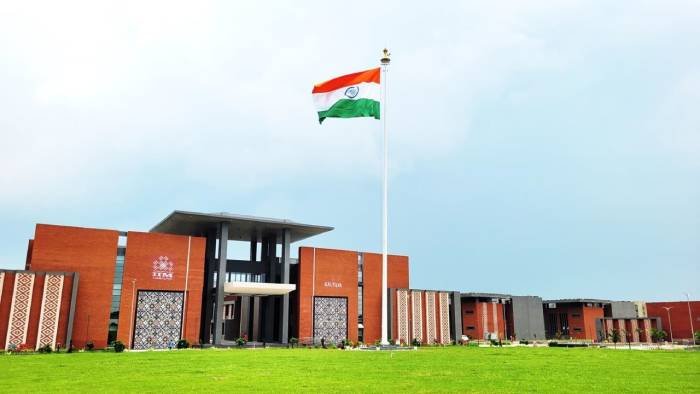
Ten years ago, IIM Sambalpur was a name on a Ministry of Human Resource Development notification and a temporary campus in Burla, Odisha. Today it is a 200-acre institution on the banks of the Mahanadi, an inaugurated permanent campus, a working incubation centre, and a management school with a specific self-description that no other IIM has claimed: the Handcrafted IIM. This is how it got there.
When India's second wave of IIMs was announced in 2014, IIM Sambalpur was one of six — sister institutions to Vishakhapatnam, Bodh Gaya, Sirmaur, Nagpur and Amritsar. On paper, they were interchangeable: same charter, same regulatory framework, same brand system inherited from the older IIMs. On the ground, they were not. Ten years in, one of them has quietly turned itself into a case study in institution-building — the kind Making of Incredible Brands was built to document.
The founding, in dates
- 2014. IIM Sambalpur is announced by the central Ministry of Human Resource Development as part of a national expansion of the IIM system.
- 19 August 2015. Registered as a Society under the Societies Registration Act, XXI of 1860.
- 23 September 2015. Formally founded. Initially mentored by IIM Indore until an independent director is appointed.
- 2 January 2021. Prime Minister Narendra Modi lays the foundation stone for the permanent campus at Basantpur, via video conference.
- 3 February 2024. PM Modi inaugurates the completed permanent campus — auditoriums, libraries, incubation centres, hostels, sports zones — on 200 acres near Goshala village, Sambalpur.
- 2025. IIM Sambalpur completes ten years. Institutional budget for FY2024–25 is estimated at ₹304.67 crore.
The compressed timeline matters. Most Indian public institutions of this scale take fifteen to twenty years to move from a temporary campus to an inaugurated permanent one. IIM Sambalpur moved to its 200-acre permanent campus within three years of the foundation stone being laid.
The name behind the name: Prof. Mahadeo Jaiswal
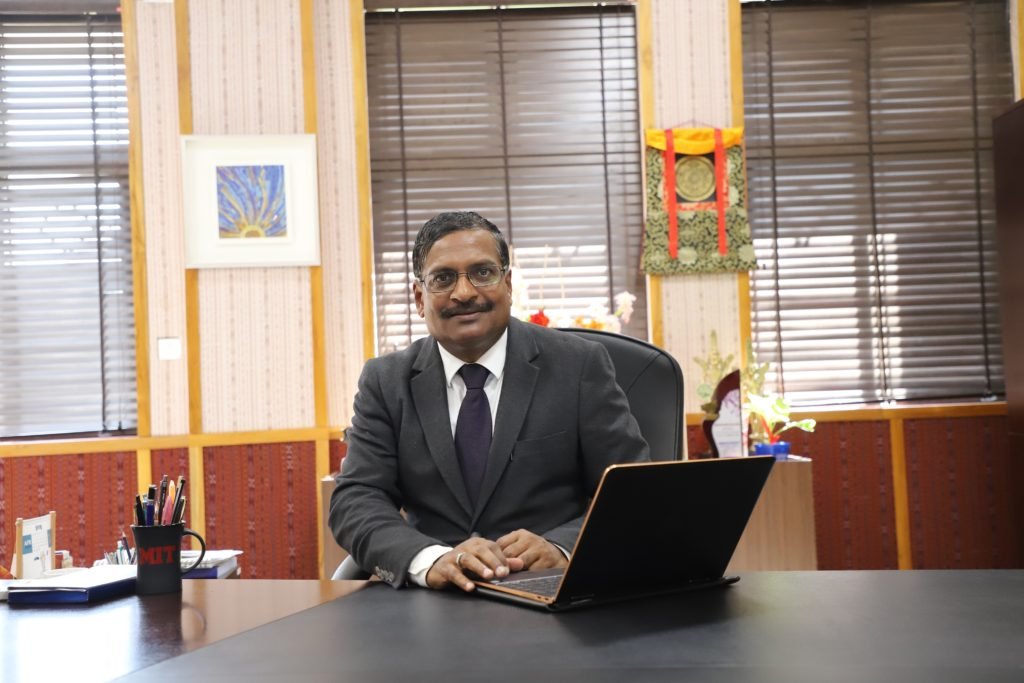
Every institution that becomes a brand has a founding figure whose specific vision is legible in the campus decades later. IIM Sambalpur has Prof. Mahadeo Jaiswal.
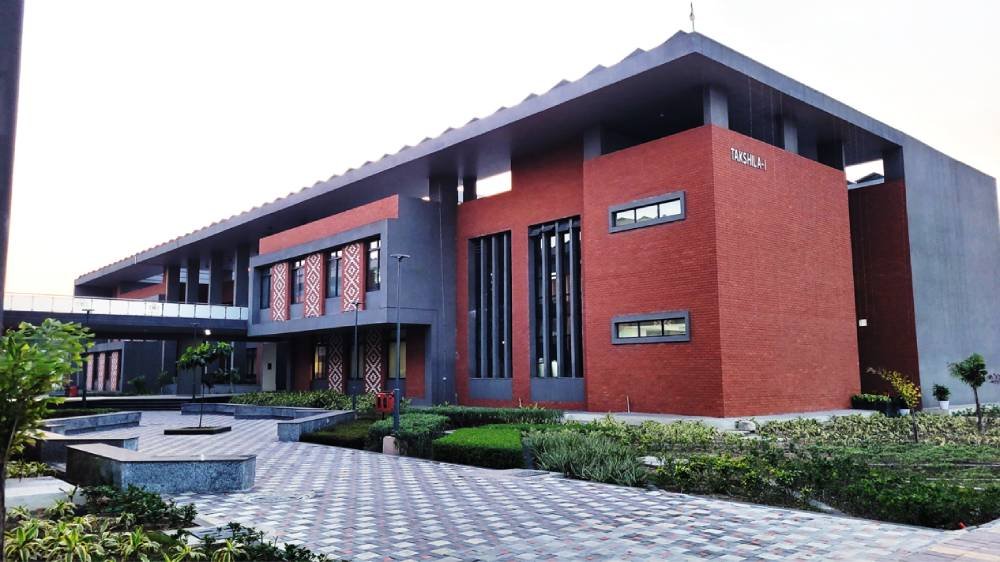
A Professor of Information Systems by training, with a Fulbright fellowship at Carnegie Mellon University's Heinz School of Public Policy and School of Computer Science, and academic time at MIT Sloan, Prof. Jaiswal took charge as the founding director in the institute's earliest years and has continued to lead it since. The 200-acre permanent campus — and its integration of regional Sambalpuri motifs into brick-and-concrete architecture — is described by the institute itself as being "inspired by the vision of Prof. Mahadeo Jaiswal, the founding director."
IIM Sambalpur thrives on its commitment to cultivating responsible leaders with entrepreneurial mindsets. Driven by our Vision and Mission, and rooted by the Core Values of Innovation, Integrity, and Inclusiveness. — Prof. Mahadeo Jaiswal, Director's Message, IIM Sambalpur
The three-word core — Innovation, Integrity, Inclusiveness — is not a marketing statement. It is the institute's Sanskrit motto in English (navasarjanam śucitā samāveśatvam) and it has held, unchanged, since founding. That is Trait 05 from our editorial framework — held consistency — in institutional form.
What "The Handcrafted IIM" actually means
The nickname is not a slogan an agency wrote. It is a description of how the institute has been assembled — one classroom, one building, one cohort at a time — in a region without the pre-existing academic gravity of a metro. The choices show up in a few specific ways.
The phrase "handcrafted" reads as branding until you notice the choices behind it. IIM Sambalpur did not open in Delhi, Mumbai, or Bengaluru. It opened in a Tier-2 city in a state that had never previously hosted an IIM, on a campus that had to be built from a foundation stone into an inaugurated institution in three calendar years, in an architectural vocabulary specific to Western Odisha. Every one of those was a decision that could have been made the easier way. None of them were.
The classroom, ten years in
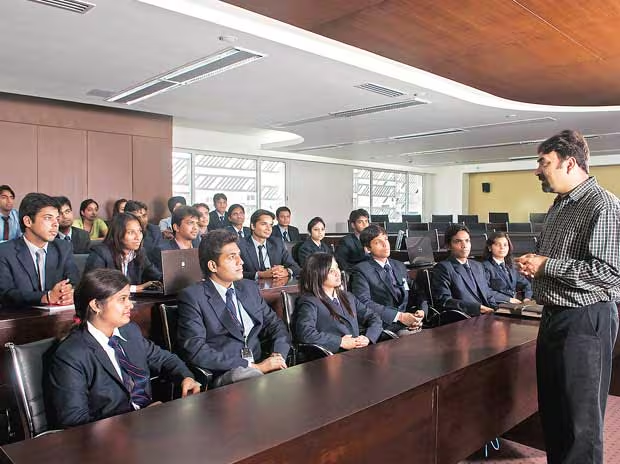
Ten years in, the numbers give the institution a specific shape. IIM Sambalpur runs at approximately 728 students — 630 postgraduates, 98 doctoral researchers — with an academic staff of 74. That ratio is deliberate. The institute could have grown the intake faster; it did not. The trade-off was scale for depth.
The programme portfolio has expanded outward from a single two-year MBA into a multi-degree institution. Today's offerings include the flagship MBA, an MBA in Business Analytics, an MBA in Fintech Management, a Bachelor of Science in Data Science & AI, a Bachelor of Science in Management & Public Policy, an Executive MBA, and PhD programmes — including a dual-degree Executive PhD with Université de Bordeaux. That is not the programme sheet of an institute still finding its footing. It is the programme sheet of an institute that has decided what it wants to be by year ten.
Faculty, and the room the institution grew into
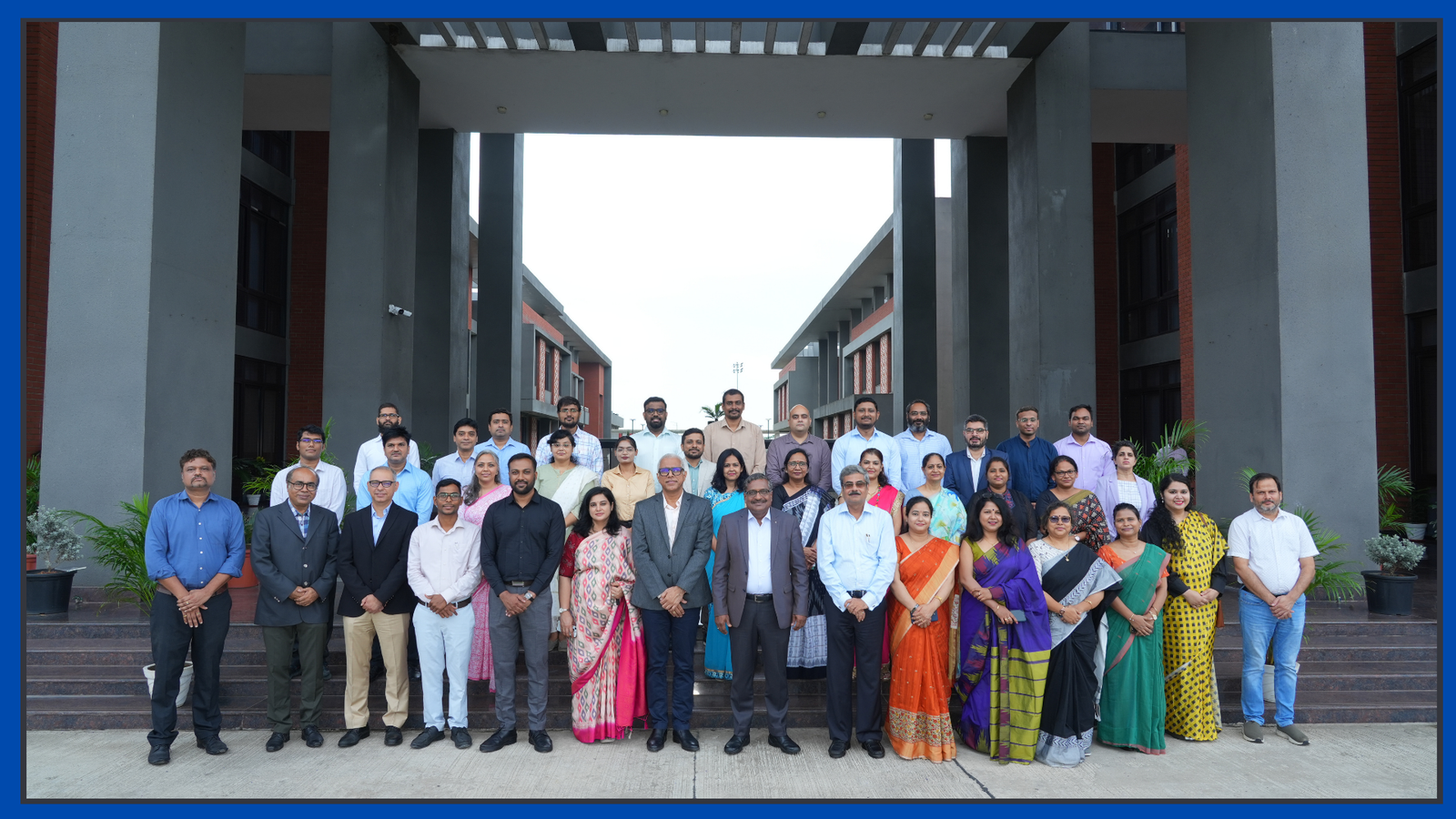
An institution's brand is not its logo. It is the room the founding director stands in ten years after opening day and looks around. The people who joined in year one because they believed in a Tier-2 Odisha IIM against every conventional recruitment odd. The people who joined in year seven because the campus was now visible on a Google Maps satellite tile. The people who will join in year fifteen because IIM Sambalpur has become a name their generation has heard.
An institution is one person's conviction, held long enough, that other people start joining the room. That is what a decade of IIM Sambalpur looks like on the steps of Basantpur.
Where they sit against the MOIB framework
Our editorial framework for this season asked what separates an incredible brand from a good company. Applied to a public institution — a category we do not usually run through the same lens — IIM Sambalpur clears a surprising number of the traits.
The through-line
Institutions are supposed to be slow. That is their virtue and their limit. Every IIM Sambalpur press release we read for this profile mentions the ten-year mark, the 200-acre campus, the inaugurations, the rankings. Fewer of them mention what actually makes the institute a case worth filming for MOIB: the specific stubbornness of building a national brand from a Tier-2 city, in a regional visual vocabulary, at a pace faster than the sector expected, with the founding director still in the room.
An incredible brand, we argued in the framework, is not a good brand made bigger. It is a specific type of brand, built with a specific type of intent, from year one. IIM Sambalpur is a public institution, not a consumer company. But the shape of the intent is the same one we filmed in warehouses, factory floors, and founder offices. Someone decided, in year one, what the institute was for. And then they refused to flinch for a decade.
A handcrafted institution is what happens when a founder resists every offer to make it bigger, faster, or more generic — until enough time passes that the specific choices become the brand.
episode on JioHotstar.
A twelve-minute feature — on the ground at Basantpur, on the record with the founding director, and in the classroom with the students the institute was built for.
IIM Sambalpur — Director's Message, Permanent Campus and Institute at a Glance pages · IIM Sambalpur Transparency Audit 2025 · Wikipedia (Indian Institute of Management Sambalpur) · Crunchbase and Google Scholar profiles of Prof. Mahadeo Jaiswal · Careers360 coverage of the 3 February 2024 inauguration · IIRF Ranking institutional profile · MBAUniverse and ServiceSetu institutional summaries.