A single episode of Making of Incredible Brands is not a video. It is a permanent asset library — a corporate AV, an investor opener, a founder-story reel, a keynote film, a hiring pitch, a sales tool, a press kit. This is the playbook for how to deploy one 12-minute JioHotstar feature across every future communication your brand will ever run — and why it beats anything you could produce in-house.
The value of an MOIB feature is not the premiere week. It's the multi-years of communication that come after.
An MOIB feature is engineered from day one to unlock 15+ downstream assets — each one a production your marketing team would otherwise commission separately, and each one distributed to India's largest streaming audience.
1 shoot
Broadcast production, once
15+
Derivative assets unlocked
8
Deployment surfaces covered
Perpetuity
Effective asset shelf life
The best-run brand-marketing teams in India already know this — and the rest are about to catch up. The problem with brand content isn't quality; it's fragmentation. A CFO writes a cheque for a corporate AV. Another cheque for the founder's LinkedIn film. Another for the investor day opener. Another for the hiring reel. Another for the retailer conference sizzle. Five separate productions, five separate crews, five separate stories that don't quite add up to one narrative — and none of them ever gets a real audience.
Now imagine collapsing all of that into a single 12–15 minute broadcast-grade feature that airs on JioHotstar, then quietly becomes the source-of-truth footage for every one of those internal briefs — for the next decade. That's the MOIB model. This piece is the playbook for what a brand actually gets from one episode, where it deploys, and why the alternative — the in-house corporate video — has quietly stopped working.
The math: one production, an entire asset library
A typical MOIB shoot delivers roughly 40–60 hours of raw footage — founder interviews, boardroom scenes, shop-floor sequences, customer footage, aerial and product B-roll, and a full editorial arc. The 12–15 minute premiere is the flagship deliverable. But it is one deliverable of many.
Here is what a single episode's footage bank is engineered to become:
01 · CORPORATE AV
A 3–5 minute company film cut for lobbies, offsites, distributor meets and orientation. The MOIB feature is essentially a broadcast-grade corporate AV that has already passed editorial review at India's largest streaming platform.
02 · BRAND SNIPPETS · 15S / 30S / 60S
Vertical and landscape social cuts — a hero moment, a founder line, a "before / after" arc. Native-length for Reels, Shorts, LinkedIn, X, and connected-TV pre-roll. Fifteen or more distinct snippets per episode.
03 · LEADERSHIP JOURNEY FILM
A 6–8 minute founder-first cut for CEO profiling, TEDx-style talks, LinkedIn "founder story" pieces, and Y-Combinator-format investor rooms. Character-driven, unbranded on top, journalist-interviewed.
04 · INVESTOR-DAY OPENER
A 90-second cold-open cut for the top of every AGM, IR presentation, roadshow deck, or funding pitch. The room warms itself — the CEO walks in already believed.
05 · EVENT SHOW-REEL
Distributor meets, annual town halls, retailer conferences, brand launches. A 3-minute high-energy cut with music, motion, and a "you're in the room" opener that replaces the emcee's warm-up entirely.
06 · SALES ENABLEMENT ASSET
A 2-minute sales-team screener sent ahead of every enterprise pitch, retailer negotiation, or channel-partner appointment. Trust is transferred before the first slide.
07 · WEBSITE HERO / ABOUT US FILM
A looped 45-second silent bumper on the home page, plus the full film on the About page. Replaces the "who we are" wall of text with one watch.
08 · HIRING & EMPLOYER-BRAND FILM
A 4-minute recruiting cut for campus placements, senior-hire outreach, LinkedIn Life pages, and Glassdoor. Answers "why should I join?" before the first interview round.
09 · PR KIT & AWARDS SUBMISSION
The film becomes the press kit for every journalist who covers the brand, the video attachment to every awards submission, and the automatic B-roll library editors pull from.
10 · CTV & YOUTUBE AD UNITS
15s / 30s / 60s cut-downs for connected-TV, YouTube pre-roll, and OTT platforms. Documentary-grade footage running as media — no additional shoot required.
11 · KEYNOTE OPENER FOR THE FOUNDER
Every founder ends up on a stage. A 90-second personal cut becomes the opener for every TEDx, industry summit, or founder-panel appearance — for years.
12 · CUSTOMER & CATEGORY REELS
Category snippets — the shopfloor story, the D2C sequence, the product-launch scene — cut as standalone films for use inside proposals, RFPs, and category conversations.
Twelve derivatives from one shoot, before you count the raw B-roll library — which itself becomes reusable stock footage every internal team draws on for years. The unit economics of this are not close: one MOIB commission costs a fraction of what commissioning each of the above separately would.
Where each asset actually deploys
Content is only worth what its distribution is worth. Here is where each cut goes to work — and the audience it earns you in that room.
SOCIAL MEDIA
Reels, Shorts, LinkedIn, X, YouTube. 60-second founder-quote cuts, "one moment that changed the company" edits, category-insight clips. Native content, not repurposed marketing.
WEBSITE
Home-page hero loop, About page full feature, Careers page life-at-brand cut, Investor Relations page leadership film. Every visitor arrives to video, not copy.
EVENTS & CONFERENCES
Distributor annuals, retailer meets, town halls, product launches, industry keynotes. The film opens the room, and the founder walks on to real applause — not polite applause.
INVESTOR MEETS
Pre-read for VC/PE pitches, IR-day opener, roadshow deck video, AGM video. A JioHotstar-vetted narrative is worth more than any deck a founder can write.
SALES & B2B
Pre-meeting screeners, enterprise RFPs, channel-partner briefings, retailer negotiations. The brand is believed before the meeting begins.
HIRING
Campus recruiting films, senior-hire outreach, LinkedIn Life page, offer-stage close video. Candidates arrive already sold on the mission.
PR & MEDIA
Press kits, TV interview B-roll, awards video attachments. Every future journalist who covers the brand starts from your footage — not their imagination.
RETAIL & POINT-OF-SALE
In-store screens, exclusive-brand-outlet reels, kiosk loops. The founder's story runs silently in every retail environment.
A single MOIB feature is not one production. It is the source-of-truth footage that every brief inside your marketing team draws from for the next decade. That's the compounding no other content format offers.
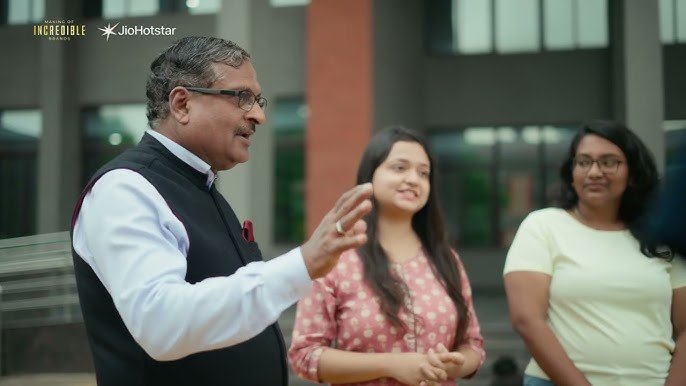
On location for the IIM Sambalpur episode of Making of Incredible Brands. Every MOIB shoot is engineered to deliver footage that plays across campus outreach, hiring, alumni communications, PR and social — from one production.
Why this beats self-produced content of the same kind
The obvious counterfactual is: why don't we just make a corporate film ourselves? Every large brand has. Every marketing team has been through the process — a production house, a scripted voice-over, a founder-to-camera shoot in a rented studio, a music track from a stock library. Two months and ₹25–50 lakh later, the film is uploaded to the About page. Six months later, no one watches it.
Here is why. It is worth going through this head-to-head — because the difference is not marginal, it is categorical.
Dr. Swati Verma, Founder of Glamveda, in her Making of Incredible Brands feature on JioHotstar. The interview format — journalist-led, unscripted, editorially cut — is what a corporate video cannot replicate at any budget.
SELF-PRODUCED CORPORATE VIDEO
MOIB FEATURE ON JIOHOTSTAR
Perceived as advertising. Scripted voice-over, brand-approved copy, no dissenting voices. The viewer reads it as marketing in the first 10 seconds and mentally clocks out.
VS
Perceived as journalism. Independent interviewer, editorial cut, JioHotstar's platform imprimatur. The viewer reads it as programming, not promotion — the trust premium is fundamental.
Lives on your domain. A microsite or YouTube upload nobody navigates to. Traffic has to be bought every quarter.
VS
Lives on India's largest OTT. Distributed to 550M MAUs on JioHotstar, discovered via cross-content recommendations. The audience arrives to you.
Production quality is a compromise. Rented studio, project-based crew, stock music. Looks fine on a laptop, thin on a 65" 4K TV.
VS
Broadcast-grade end-to-end. Feature DoPs, cinematic grade, composed score, colour-managed for CTV. Airs on the same screen that runs IPL and Dhurandhar.
Founder is coached. Reads from a teleprompter, delivers approved messaging. The performance shows — the audience feels the script.
VS
Founder is interviewed. Unscripted, journalist-led conversation, real answers to real questions. The audience feels the truth.
One asset, one purpose. Commissioned for a single brief (usually "the AGM opener"). The other 11 briefs need 11 more productions.
VS
One shoot, twelve+ assets. Corporate AV, founder film, sales reel, hiring cut, ad units, PR B-roll — all engineered into the same production plan.
Six-month shelf life. Revised, replaced, or forgotten within a year. Feels dated the moment leadership or product changes.
VS
Ten-year shelf life. A canonical documentary of the brand at a moment in time. Gains value as the company scales — not less.
Zero third-party validation. If the brand says it, the audience discounts it. No external editorial has vouched for the story.
VS
JioHotstar-vetted narrative. The platform's editorial commissioning process is the third-party filter. Selection is a signal — and the market reads it.
Awkward at investor meets. An in-house film in an IR room reads as brochure content — investors discount it.
VS
An unfair advantage in the IR room. "Here is our JioHotstar feature" is a different conversation. The film is the credential.
Cost per usable minute: high. A corporate film delivers one film. Cost is amortised across one artefact.
VS
Cost per usable minute: dramatically lower. The same investment amortises across a feature, twelve derivatives, and multi-year deployment. The CFO math is closer to infrastructure than to marketing.
In-house films are made to survive review. MOIB features are made to survive the audience. Those are two entirely different products — priced separately, deployed separately, remembered separately.
The three multipliers that only MOIB delivers
Set aside the derivative-count and the shelf-life for a moment. Three things a brand can never build in-house, no matter the budget, are what make an MOIB feature strategically different from any corporate film — however well-produced.
01 · Third-party editorial credibility
A brand talking about itself has a floor of trust it cannot rise above. A journalist-led editorial documentary about the brand — vetted by a national streaming platform — has a ceiling that starts above where the in-house film's ceiling ends. This is not a rhetorical distinction; it is a measurable effect on brand-lift, recall, and consideration. Selection is the signal.
02 · The JioHotstar imprimatur
JioHotstar's originals slate is a curated shelf next to Criminal Justice, Dhurandhar, IPL, and the country's top reality franchises. Landing on that shelf means the platform has made an editorial commitment to your brand's story. That commitment carries into every subsequent deployment — "as seen on JioHotstar" is a badge no self-produced film can wear, and no amount of paid media can buy retroactively.
03 · Discoverability without a media plan
The single biggest hidden cost of an in-house corporate film is getting anyone to watch it. A brand-uploaded YouTube video needs a paid-media plan behind it to reach even a fraction of the audience an MOIB episode reaches organically in its opening week. On JioHotstar, the same audience is already there — 550M of them, most of them within the exact demographic the brand is trying to reach.
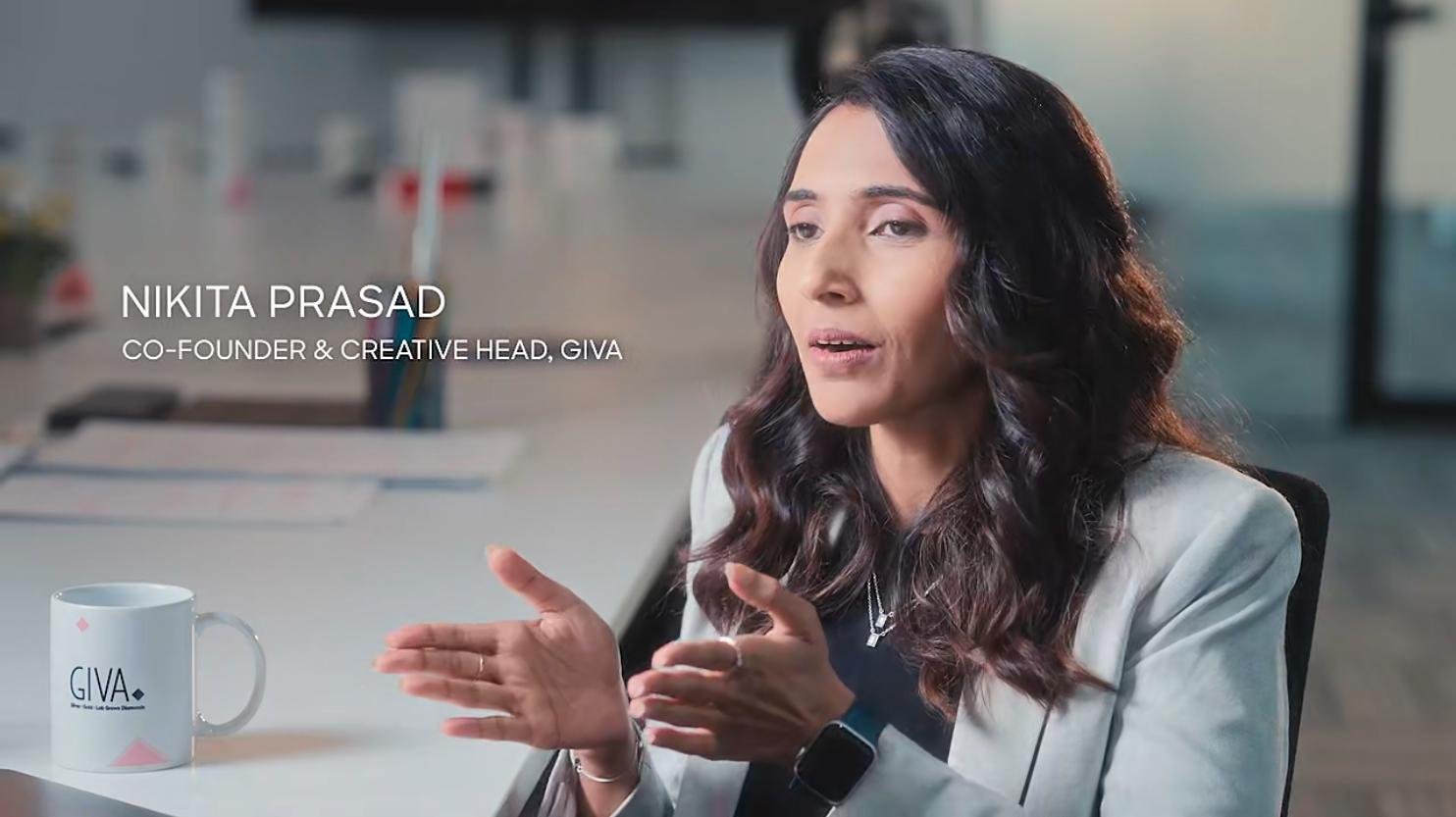
Nikita Prasad, Co-Founder & Creative Head of GIVA, mid-interview on Making of Incredible Brands. An MOIB episode reaches its first-week audience where India actually watches — on JioHotstar. Not on a corporate LinkedIn upload.
One narrative, one visual grammar, one source of truth
The other quiet cost of the in-house model is fragmentation. The AGM film, the LinkedIn founder cut, the campus-recruiting reel, the retailer sizzle, the IR-day opener, the website refresh, the social clips — each is briefed separately, produced by a different vendor, shot in a different visual grammar, and tells a slightly different version of the brand. A story that never quite adds up to one story anywhere.
An MOIB feature replaces that entire content backlog with one shoot, one narrative, one visual grammar, and one national-scale premiere on JioHotstar. Every derivative comes out of the same footage bank. Every touchpoint says the same thing. Every viewer — investor, hire, customer, retailer, journalist — meets the same version of the brand.
Brand consistency isn't a design system. It's whether the version of your brand that lands on the investor's screen matches the version that lands on the campus-hire's LinkedIn. In-house films can't guarantee that. One MOIB feature does.
The strategic reframe
The category "corporate video" was invented for a world where the only distribution surfaces a brand had were its own reception TV, its own website, and its own YouTube channel. In 2026 that world has ended. The dominant distribution surface is JioHotstar. The dominant creative unit is the compact editorial feature. The dominant credential is having your story told by a third party — not producing your own.
Brands that make the shift early will end this decade with a canonical documentary of their business that plays on the country's biggest screens, sits on every derivative surface they need, and appreciates in value every year. Brands that stay with the in-house-video model will spend the same money — and end the decade with a folder of forgotten uploads.
TURN ONE SHOOT INTO A DECADE OF ASSETS
Season 2 of Making of Incredible Brands is casting now.
One feature. Twelve derivatives. Eight deployment surfaces. Ten-year shelf life. Streaming on JioHotstar. Talk to us about your brand's story — and every future communication that story unlocks.

.jpg)