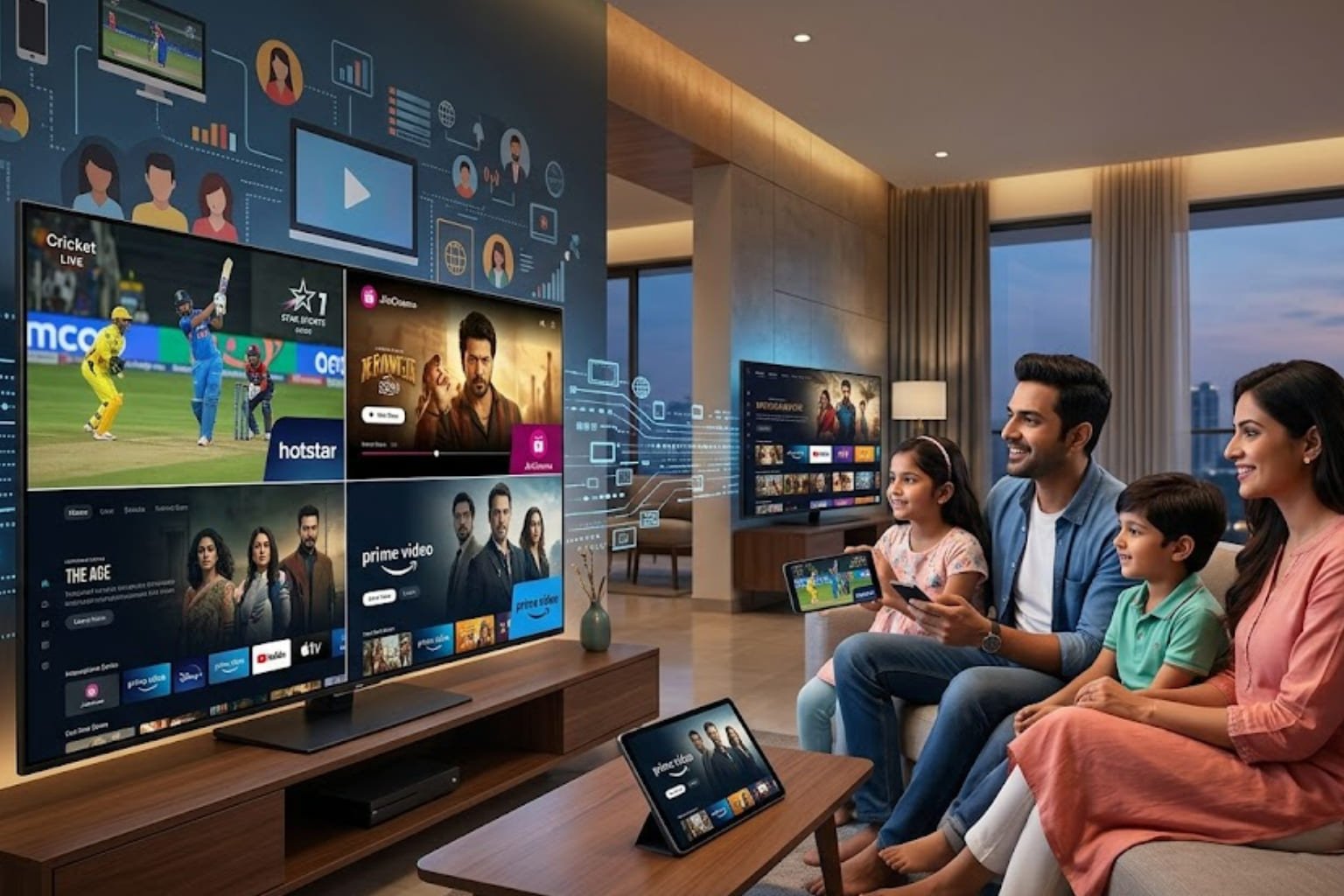
Between 2019 and 2026, India built the world's second-largest streaming audience — and quietly rewrote what a "brand campaign" can be. The 30-second spot didn't die; it just stopped being the only room in the house. The new room is 12 to 15 minutes long, sits on OTT, and it's where the country's most-admired companies are choosing to tell their real story.
Ask a founder in Mumbai or Bengaluru today what changed, and the answer keeps landing in the same place: the audience will sit for a real story now — if you don't waste their time. They'll watch you take apart your first product launch, your near-collapse in year three, the pivot that saved the company. Not for 42 minutes. Not for 60 seconds. For a compact, high-density 12–15-minute feature — long enough to be true, short enough to finish in one sitting. And they'll do it on their phone, at 11 PM, on JioHotstar.
This is a piece about why that shift is real, why the format matters as much as the platform, and why — if you are the founder or CMO of an Indian brand — the next 24 months are the window.
The market: bigger than any brand campaign will ever be
Start with the ground truth. India's OTT market reached USD 5.4 billion in 2025 and is projected to reach USD 28.1 billion by 2034 — a 19.09% compounded annual growth rate that will make it one of the fastest-expanding streaming economies on earth (IMARC Group, 2026).
The audience side is even more emphatic. India's streaming user base is expected to grow from 521 million in 2025 to 549 million in 2026, and cross 634 million by 2029. Around 65% of Indian consumers now prefer streaming services over traditional television for their entertainment needs — the crossover has already happened.
Two structural forces are behind this. First, Jio's data pricing has made streaming close to free at the margin for hundreds of millions of new internet users. Second, the smartphone has replaced the living-room television as the primary "first screen" for a generation of consumers under 35 — the exact demographic that decides whether your brand is worth talking about at all.
Indian audiences are now watching longer, deeper, and later than any traditional television audience the country has ever had. They are also more willing to sit with a real story — including a brand's — if that story is honest. — GMO Media, Field Research 2026
The category shift: non-fiction is the new prime time
Non-fiction — documentary, business storytelling, docu-drama, reality — is now the fastest-growing category on Indian streaming. Where scripted originals were the story of 2018–2022, the next chapter is being written by real founders, real workplaces, and real stakes.
Three things happened at once:
- Shark Tank India proved a mainstream Indian audience will sit for two hours of P&L talk if the characters are real. Non-fiction stopped being a niche.
- Regional-language non-fiction (Marathi, Tamil, Bengali) started monetising fastest through branded partnerships, not subscriptions — clean signal that advertisers had found the format.
- The 12–15 minute feature episode — long enough to build a story with stakes, short enough to hold attention on a phone — emerged as the format non-fiction viewers actually complete.
Industry conversations across Zee5, MX Player and Planet Marathi have converged on the same view: brands are open to differentiated concepts and formats, as long as it is entertaining. The friction that used to sit between a marketer and a streaming platform — "will your integration ruin my show?" — has collapsed inside non-fiction, because in non-fiction the brand is the show.
Why compact — not long-format, not short-form
The interesting design decision on Making of Incredible Brands was never "long-form vs. short-form." It was the right length for the story we're actually telling. And after a full season, the answer keeps landing at 12 to 15 minutes per episode — a deliberately compact feature, not a 42-minute streaming doc, not a 60-second reel.
Here's what that gets you that the alternatives don't:
Long-format brand documentaries — the 42-minute Netflix template — were built for platforms, not for brands. They ask a viewer for a full evening to hear a story that could be told more powerfully in a third of the time. Padding shows up as re-enactments, filler B-roll, and a slow first act. On a phone, at 11 PM, that first act is where you lose the audience.
Short-form on Instagram, YouTube Shorts, or LinkedIn does the opposite — it under-tells. A 60-second edit can announce a brand story, but it cannot argue for it. There is no room for the mentor's advice at year three, no room for the shopfloor scene, no room for the number that reframes everything. A short-form clip is a trailer for a story that then has nowhere to live.
The 12–15 minute compact feature is the honest middle. It is:
- Denser than long-format. A season's worth of feature episodes covers more ground than a single 42-minute film, because every minute is earning.
- Deeper than short-form. There is genuine room for a founder's voice, category context, and the moment that changed the business — the exact things a reel cannot carry.
- Native to how India actually watches. Chrome OTT data shows the sweet spot for non-fiction completion on mobile-first viewing sessions sits well under 20 minutes. Compact is not a compromise; it is the format the behaviour demanded.
- Bingeable without being a commitment. Three episodes of MOIB in a row is 45 minutes — the length of one long-format doc, with three times the surface area and three brand stories, not one.
A 12-minute feature is not "a short documentary." It is a fundamentally different unit of storytelling — sized for the phone, dense enough to argue a thesis, and built to be watched to the credits.
Why brand docuseries specifically
A brand docuseries does three things a spot cannot:
- It compounds. A 30-second ad decays the day the plan ends. A 12-minute feature episode sits on a platform, gets discovered again, gets shared, gets clipped for social, gets re-cut for a keynote — a distribution long-tail measured in years, not weeks.
- It builds trust the ad-format cannot. When a founder appears on camera, on the record, with an interviewer they don't control, the audience reads it as evidence. Category-leading brands don't need more awareness — they need to be believed. That is what feature-length storytelling does.
- It gives every stakeholder — investors, hires, retailers, regulators, journalists — one canonical story to point at. It replaces twelve decks with one film.
The platform question: why JioHotstar is the answer
You can build the best 12-minute feature in the country. If it doesn't land in front of an audience, it isn't a documentary — it's a corporate video. Distribution is not a footnote in this business; it's the whole game. And in India in 2026, the distribution answer has consolidated.
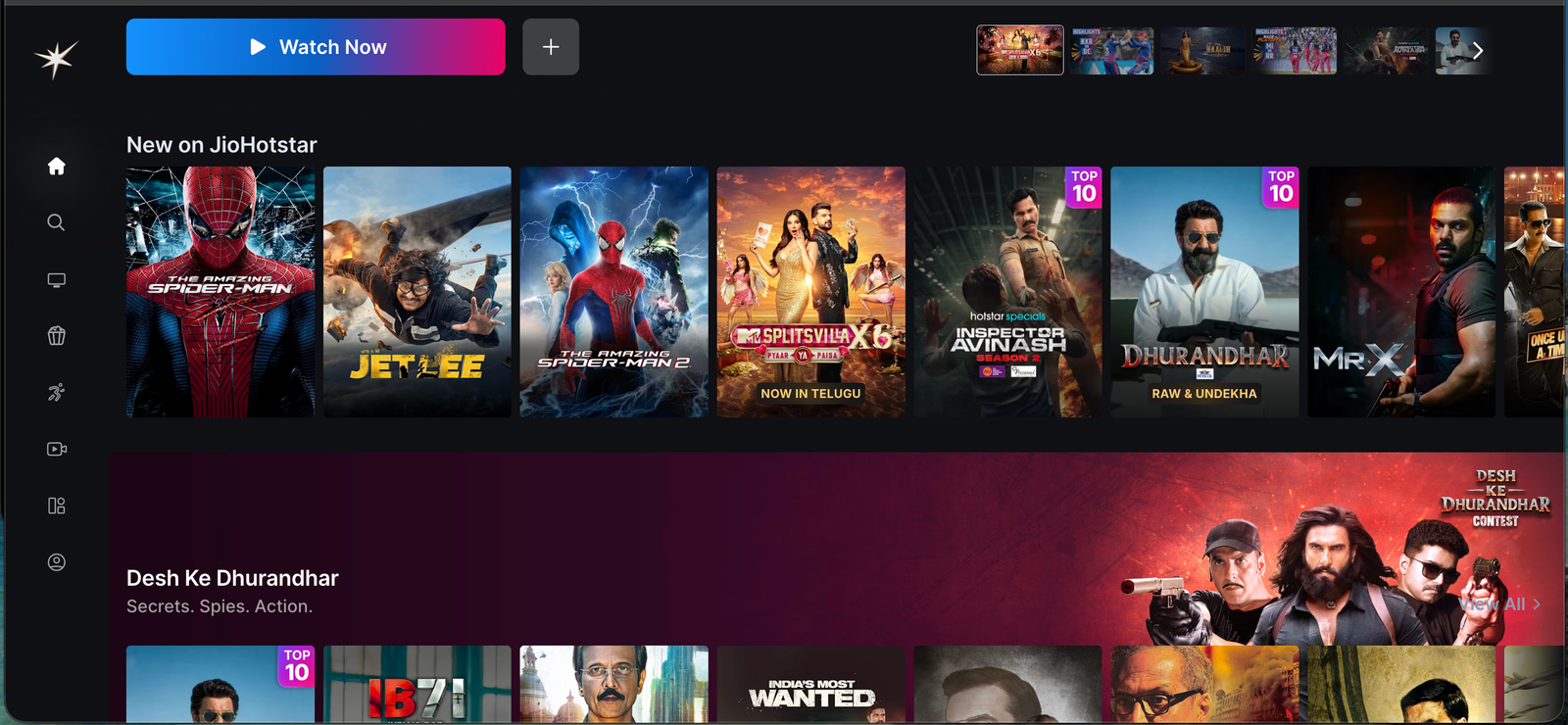
JioHotstar is India's largest OTT platform by every meaningful metric. The scale is difficult to overstate:
Chrome OTT's Week 21, 2026 panel put the platform's reach at 93.88% of surveyed Indian OTT viewers — a number no other single platform in the country comes close to. When Indian Idol, Taarak Mehta, Anupamaa, Laughter Chefs and Naagin all live under one distribution roof, non-fiction discoverability compounds with them.
What this means for a brand documentary is straightforward: you can commission one series and reach a first-week audience that would take a national TV buy months to assemble, at a fraction of the CPM, with a shelf life measured in years.
A viewer who has just spent 12 uninterrupted minutes with your founder is not the same viewer as one who has just skipped your pre-roll. They are the audience every category leader wishes they had. And they are already on JioHotstar.
Why not YouTube, Instagram, or a brand microsite?
Because context is the whole product.
YouTube can deliver a bigger raw view count. But a YouTube view is context-blind — it might be a distracted swipe on a phone in a canteen. A JioHotstar viewer sitting through a documentary episode has explicitly chosen premium content, on a premium screen (Fire TV, connected TV, laptop) in premium moments (evening, weekend). That is the difference between reach and reach-that-changes-mind. Non-fiction, in particular, has always paid off for platforms where the viewer trusts the environment.
Instagram and brand microsites, meanwhile, are excellent amplifiers for a docuseries — but they are not the primary home. A brand story that lives only on your own domain gets seen by the audience you already own. A brand story on JioHotstar gets seen by the audience you're trying to earn.
The economics: why this is cheaper than it looks
Brand teams hear "docuseries" and reach for the number they'd spend on a TV campaign. That's the wrong benchmark. The right benchmark is fully-loaded cost per meaningful minute with your audience.
- A 30-second ad, at national reach, buys you 30 seconds. A branded compact feature buys you 12–15 minutes of watched, completed attention — often the deepest attention a viewer will give any brand all year.
- The episode is asset-heavy: it is cut down into 60-second social clips, 3-minute YouTube pieces, LinkedIn founder-story reels, sales-team screening reels, event show-reels, and press assets — one production, dozens of derivatives.
- OTT ARPU in India is climbing (projected USD 40.44 in 2026) — the audience is worth more per head to platforms every year, which is exactly why platforms are actively looking for premium branded non-fiction to slot into their originals grid.
In short: the CFO math on a compact-feature docuseries is closer to a piece of long-life infrastructure than a media buy.
The afterlife: one film, ten years of brand communication
This is the part that gets under-discussed, and it's the part that changes the ROI conversation entirely. A JioHotstar premiere is the launch, not the destination. Once the episode exists, it becomes a permanent, brand-owned asset that plugs into every future communication the brand runs — for years.
Here is what a single 12–15 minute feature turns into once it airs:
Put together, this is the difference. A television campaign ends when the media plan ends. A branded feature on JioHotstar becomes a permanent building block of how the brand communicates for the next decade — a piece of infrastructure that keeps paying back long after its premiere week.
The best ad you'll run in 2028 is a two-minute cut of the feature you shot in 2026. The best hiring pitch, the best keynote opener, the best investor moment — same source. That's the compounding no other brand format offers.
What the next 24 months look like
Three forecasts we're comfortable underwriting:
- The branded docuseries becomes a standing line item in the top 200 Indian brand marketing budgets by end of 2027 — the same way the "annual film" was a standing line item for FMCG brands in the 1990s.
- Regional-language brand docs will scale faster than English ones, mirroring where OTT growth itself is — Tier-2/Tier-3, vernacular, mobile-first.
- JioHotstar's non-fiction slate will double as Season 2, 3 and 4 of business-storytelling franchises like Making of Incredible Brands extend the category the way scripted originals extended fiction between 2018–2022.
What this means for you, if you're a brand
If your brand has an actual story — a category built from zero, a comeback, a bet that shouldn't have worked, a founder worth putting on camera — the window to be an early brand docuseries on India's dominant OTT platform is still open. It will not stay open long. The best slots on the next two seasons of business non-fiction on JioHotstar will be booked in the next 12 months. Category exclusivity, once given, doesn't come back.
The brands that used the 1990s to make the definitive TV ad are still on our shortlist thirty years later. The brands that use 2026–2028 to make the definitive brand documentary will still be on the shortlist in 2056.
Every incredible brand has a moment nobody sees. Put that moment on screen. Put it on JioHotstar. Watch what happens next.
Season 2 of Making of Incredible Brands.
GMO Media is currently casting Season 2 for premiere on JioHotstar. Selection is by shortlist, on category exclusivity, from now through Q4 2026.
IMARC Group India OTT Market Report 2026–2034 · Chrome OTT Panel, Week 21 2026 · Sci-Tech Today Indian OTT Platform Statistics 2026 · Decentro Top 12 OTT Platforms in India · Statista JioHotstar Subscriber Report (Financial Express, June 2025) · MarketResearchFuture India OTT Market 2035 · BuzzInContent Non-Fiction Branded Content Reports · GMO Media Field Research 2026.