Every episode of Making of Incredible Brands lives on the JioHotstar shelf next to feature films, IPL, and the most-watched originals in the country. The bar is not "good for a branded film." The bar is good enough to sit next to whatever the viewer was going to watch tonight. That bar is impossible to hit with a traditional post-production workflow — the calendar and the budget won't let you. It is entirely possible to hit with a hybrid one.
This is a note from the studio floor. It's not an argument for AI replacing anyone in the cutting room — nothing in our workflow does that. It's a description of how the modern documentary post-production team actually operates in 2026, when every mechanical task in the chain has an AI tool sitting next to it, and the editor's real job — deciding what the film is — becomes the only job left that matters.
The post-production bottleneck no brand film ever solved
Ask any documentary editor what actually takes the time on a shoot-heavy project like MOIB, and you'll get the same list:
- Transcription and logging. Twenty hours of interview footage, three founders, four languages between them. Nothing gets cut until you can search the footage.
- Sync, roto and clean-up. Location audio with a Mumbai traffic bed. A boom that clipped in scene 4. A wire that shows up in the wide shot.
- Colour and finishing. Ten interview setups across three cities, six different lighting conditions, all cut into one film that has to feel like one film.
- Localisation. Hindi, English, sometimes Marathi or Tamil for the founder's own words — plus a burnt-in caption track for the phone-viewer at 11 PM.
Historically, these four buckets ate 60–70% of the post-production calendar — and they were the reason a good branded film cost what it cost, and took as long as it took. They were also the reason the CFO decided one big film was enough for the year, and the founder story lived in the deck instead.
What has actually changed in the last 24 months isn't the creative craft. It's that the four buckets above are now — for the first time — compressible.
The camera didn't get smarter in the last two years. The cutting room did. That's the shift MOIB is built on.
The GMO Media AI stack — four rails, one film
Our post-production for MOIB is organised around four rails: Vision, Sound, Story, and Finish. Each rail combines the editor and director's judgement with the best-available AI tool for the mechanical work on that rail. The tools evolve; the human decision points don't.
Picture, cleanup & finish
Every frame that lands in the timeline gets touched by at least one AI-assisted pass — cleaning up noise, filling gaps, and freeing the DOP and editor to focus on framing, pacing, and story.
- DaVinci Resolve Neural Engine — Magic Mask, SuperScale, Depth Map for cinematic depth grading.
- Topaz Video AI — 4K upscaling of legacy archive and phone-shot founder moments.
- Adobe Premiere Firefly — Generative Extend, object removal, background clean-up.
- Runway ML — Motion Brush and background replacement for tight-schedule pickups.
Location audio, dialogue & mix
Documentary sound is where films are quietly won or lost. AI-driven audio restoration lets us shoot in real locations — a factory floor, a founder's living room — without accepting the acoustics as a limit.
- Adobe Enhance Speech — studio-grade dialogue from field recordings.
- iZotope RX 11 — de-noise, de-reverb, and spectral repair on interview tracks.
- ElevenLabs — multilingual voice cloning for dub layers, always with talent consent.
- Whisper (multilingual) — foundation transcription across Hindi, English, and regional-language interviews.
Transcripts, structure & rough cuts
The single biggest time saving. Twenty hours of raw interview becomes a fully searchable, script-aligned document within hours — so the director and editor spend their week choosing moments, not looking for them.
- Descript — transcript-based edit; cut the doc by editing the text.
- Adobe Premiere Text-Based Editing — same principle, native inside our finishing NLE.
- Frame.io Camera-to-Cloud — footage is transcribed and logged before the flight home.
- Custom in-house LLM prompts — quote pulls, theme clustering, arc suggestions the editor reviews.
Colour, VFX & delivery
Broadcast delivery for JioHotstar demands a level of QC that used to sit only inside big studios. AI-assisted finishing has moved that quality bar within reach of a nimble, focused team.
- Colourlab.ai — shot-matching across multi-camera, multi-location interview grades.
- Boris FX Silhouette / Continuum — AI-assisted rotoscoping and clean-up for reveal shots.
- Nvidia Broadcast Studio — real-time noise floor management on remote interview cuts.
- Auphonic — loudness compliance to the JioHotstar delivery spec on final master.
Each of these tools does something a human editor could do — has always done, in fact. What changes is that they do it in minutes instead of days, at a quality that meets a broadcast panel's approval. That reclaimed time doesn't disappear — it goes back into the parts of the film that AI has no opinion about.
The editor is still the director of the film
This is the sentence we come back to on every project. AI does not decide which quote lands the founder's arc. It does not decide when the film pauses for silence. It does not decide whether scene 6 or scene 12 opens the episode. Those are craft decisions, and they are made — every single time — by a human editor and a human director in a room together.
What the AI stack does is compress the distance between a creative idea and the version of the film that lets us test that idea. In 2020, changing the structure of an act meant a week of re-cutting. In 2026, it can mean an afternoon. When the price of iteration drops by an order of magnitude, the film gets iterated more — and iteration is where documentary films get good.
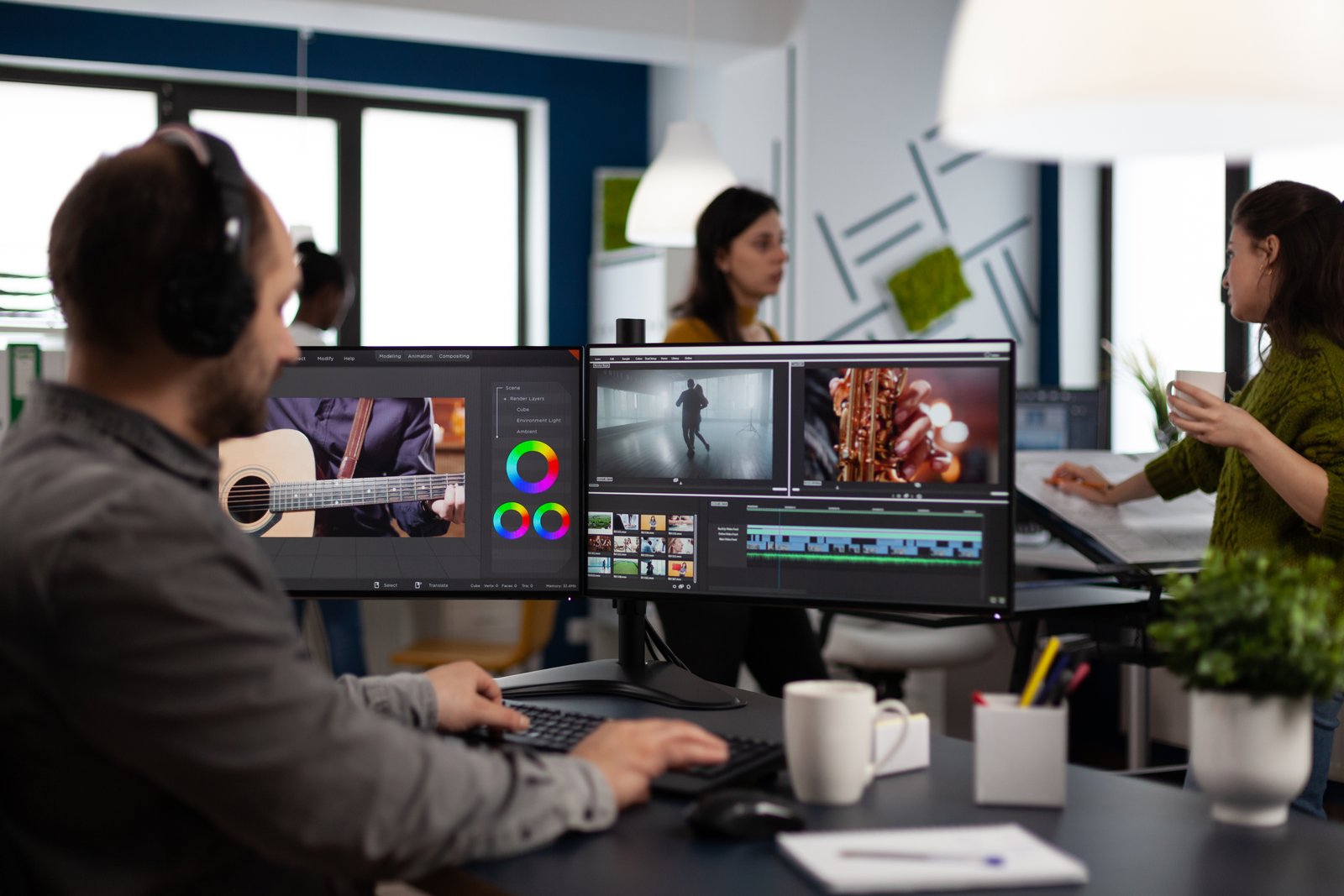
The best use of AI in post-production isn't to make films faster than a human. It's to make the film the human wanted to make, in the calendar the project was actually given. — From the MOIB Studio Notes, 2026
What this unlocks for MOIB — and for the brands in it
The economics of documentary post-production have always run against branded work. A traditional edit suite billed for eight weeks meant a shortlist of about four brands per season. Compress the mechanical rails, and the same team can do more brands, at the same quality, in the same calendar — without hiring an army or cutting corners on story.
For the brands who appear in the series, the shift shows up as:
Faster premieres, better slots
Compressed post means we can align a brand's episode to a real category moment — a launch quarter, an anniversary, an IPL adjacency window — instead of shipping whenever the edit finishes.
Every episode gets the full VFX + finishing pass
AI-assisted colour, clean-up, and audio restoration mean nothing gets cut for "we ran out of time in post." Every brand's film is finished to the same broadcast bar.
Multi-language delivery, day one
Hindi, English, and one regional language on the day of premiere — not as a phase-two release. Transcripts, dubs, and subtitles come out of the same AI-assisted pass, reviewed by human language editors.
The derivative library, built alongside the episode
The 15 downstream assets — social clips, keynote reels, investor cuts, hiring films — come out of the same NLE session, not a second brief. That's ten more assets per brand, at zero incremental shoot cost.
Cost structures that make more brand stories viable
Every hour AI saves on the mechanical rail is an hour the team can spend on a founder interview, a location recce, or a script rewrite. The film gets better and the invoice gets smaller.
The guardrails we don't cross
AI in post-production has failure modes. We've spent a year drawing lines we don't move:
- No AI-generated footage passed off as real. Reconstructions, if used at all, are always marked and always disclosed. A documentary lives on trust.
- No voice cloning of a founder without their explicit consent and review. Dubs, where used, are signed off by the person being dubbed.
- No AI face-swap or de-ageing on real people. Ever.
- Every AI-assisted cut is reviewed by a human editor before it leaves the suite. Rough cuts assembled by the transcript engine are a starting point, not a delivery.
- Nothing goes to a brand or to JioHotstar unless a director signs off frame-by-frame.
These aren't legal footnotes. They are the reason MOIB is trusted by the founders who agree to sit in front of the camera. A documentary is a promise about accuracy — the moment the audience stops believing that promise, the format ends.
The industry direction — and why India is well-positioned
Every major studio, streamer, and post-house globally is running some version of the hybrid model we've described. Adobe's 2025 developer survey put professional adoption of generative-AI post tools at over half of surveyed editors. Blackmagic Design's Neural Engine has become a default part of the Resolve grade panel, not an optional plug-in. Frame.io's Camera-to-Cloud is standard on major streaming productions. The direction of travel isn't ambiguous.
India's advantage in this shift is unusually strong. The country's post-production talent pool is among the largest in the world, built by decades of work on Bollywood, regional cinema, VFX for global studios, and a fast-scaling advertising sector. Layered on top of that talent, AI tools compound rather than replace — a senior Indian editor now runs a workflow that would have needed a much larger team five years ago, and can deliver at a cost point that makes more brand documentaries viable, not fewer.
The story of Indian post-production in the next five years won't be humans versus AI. It will be Indian editors, using every tool in the modern stack, producing more premium non-fiction than any country in the world.
Why this matters to a brand thinking about MOIB
The straight answer: it means your brand's story on MOIB will be produced to a bar that, five years ago, only a Netflix commission could reach — and delivered in a calendar that, five years ago, would have been impossible on any commission.
It also means the derivative asset library — the 15+ downstream pieces we build alongside each episode — is a real deliverable, not a footnote. The AI stack is the reason we can promise that. The editor's craft is the reason we can promise it will be good.
built for the way India watches now.
GMO Media is currently casting Season 2 of Making of Incredible Brands for JioHotstar. If your brand has a story worth putting on the shelf next to the biggest films in the country, write to us.
Adobe Premiere Pro + Firefly · DaVinci Resolve Neural Engine · Runway ML · Topaz Video AI · Descript · Frame.io Camera-to-Cloud · iZotope RX · Adobe Enhance Speech · ElevenLabs · OpenAI Whisper · Colourlab.ai · Boris FX Silhouette / Continuum · Nvidia Broadcast Studio · Auphonic. All tools used under commercial licence. Consent and disclosure protocols apply on all AI-assisted content. GMO Media Studio Notes, August 2026.