In February 2025, two of the biggest names in Indian media stopped fighting each other and merged. Eighteen months later, the platform they created is the most-used OTT service in the country's history — and one of the largest streaming platforms on earth. This is the story of how that happened, and what it means for the next decade of Indian media.
Every few decades an Indian medium hits an inflection point. Radio in the 1950s. Colour television at the 1982 Asian Games. Cable in the 1990s. DTH in the 2000s. Each time, the map of how a billion people got their entertainment was redrawn in a single quarter. 2025–26 was that quarter for streaming. And the platform doing the redrawing has a name — JioHotstar.
The numbers alone would be enough. 550 million monthly active users by March 2026, ₹31,048 crore in media revenue for FY26, more than a billion Android downloads, and availability on 99% of India's connected TV devices. But the numbers under-tell what actually happened. What happened is that a country of 1.4 billion people got, for the first time, a single screen it could all agree to watch at the same time. On JioHotstar, an IPL final now streams to more people simultaneously than most nations have citizens.
The merger that made a monopoly of attention
Rewind to late 2024. Two companies with two of India's most valuable content stacks — Disney's Star India (owner of Disney+ Hotstar and the Star TV network) and Reliance's Viacom18 (owner of JioCinema and the Colors network) — announced they would combine into a single joint venture. The deal, valued at roughly $8.5 billion, closed in November 2024. Viacom18 and Reliance took a 63.16% stake; Disney retained 36.84%. In February 2025, Disney+ Hotstar and JioCinema shut down as separate apps and re-launched under one roof, one brand, one login: JioHotstar.
Combining the two platforms did four things simultaneously — and it is worth naming each, because most industry commentary conflates them:
- It consolidated cricket rights. The IPL digital rights (Viacom18) and Star's linear rights sat under one owner for the first time in a decade — meaning a viewer no longer had to choose which app to watch a match on.
- It merged two of India's largest content libraries. Disney's international slate (Marvel, Star Wars, Pixar, HBO, Peacock, Paramount) landed next to Viacom18's Indian originals and Colors TV catalogue — a combined library of more than 300,000 hours.
- It solved the free-tier question. JioCinema's free IPL had reset audience expectations in 2023; JioHotstar inherited that behaviour and paired it with Hotstar's premium subscription base.
- It ended the fragmentation of Indian streaming. Overnight, "which app should I subscribe to?" collapsed from a five-way decision into a two-way one — JioHotstar, and one everyone-else.
The strategic logic was blunt: whoever owns cricket in India owns attention in India. And cricket, in 2025, decisively belonged to a single platform.
The Disney–Reliance merger was not a media deal. It was an infrastructure deal. It gave India, for the first time, a single national streaming utility. — MOIB Editorial Desk
The market share picture: JioHotstar leads, and the gap keeps widening
Streaming market share in India is famously hard to measure — different agencies count different things (revenue, subscribers, MAUs, watch time, reach) and different weeks look different because of what's live. But every credible measure in 2026 points the same way.
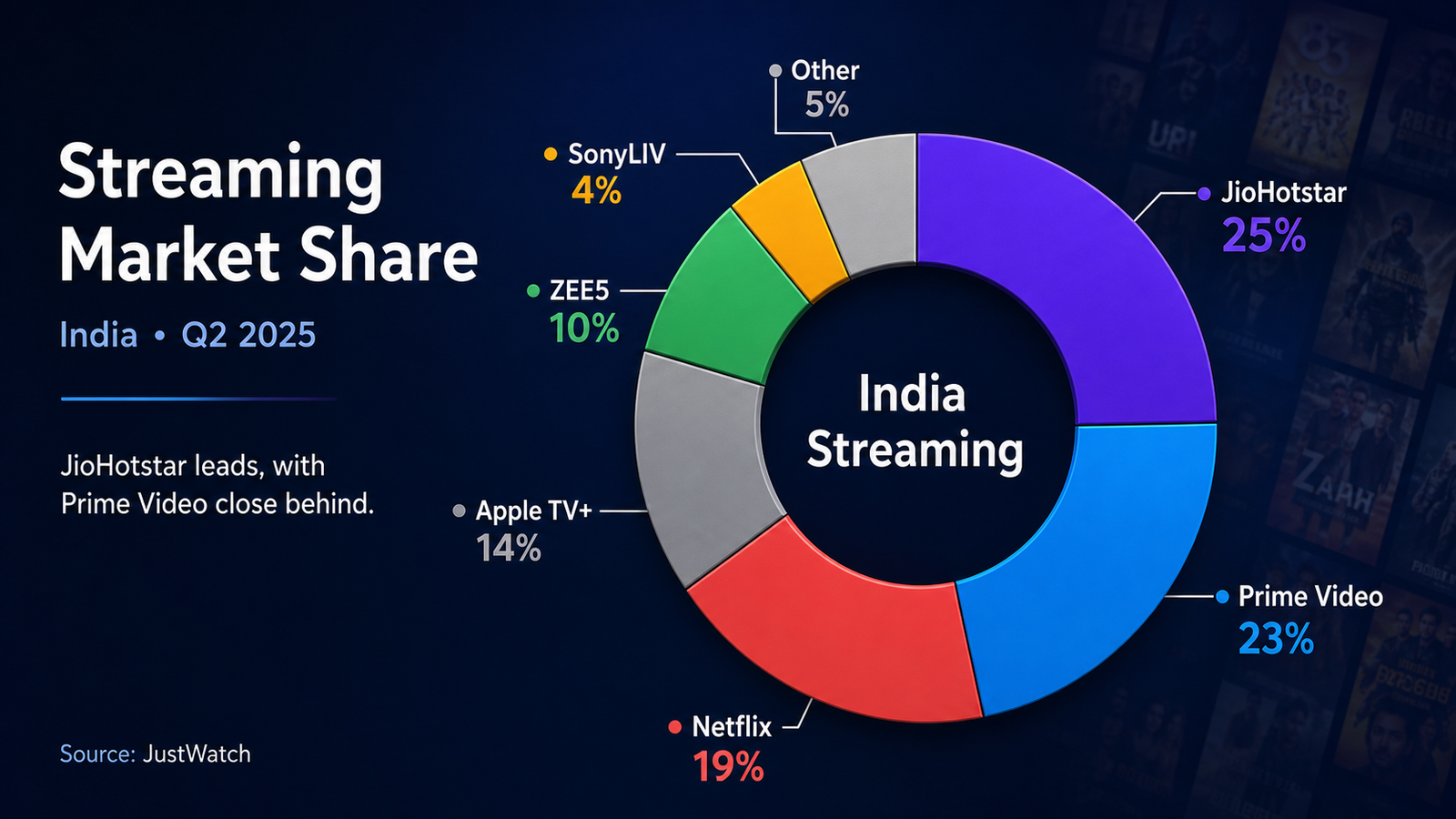
By share of subscription streaming market, JioHotstar is number one. Different analysts triangulate to different figures — Decentro puts it at 35–40% of SVOD revenue and over 50% of subscriber volume; Entertainstar puts SVOD share at 31%; JustWatch's Q2 2025 panel put weekly SVOD share at 25% — but the ordering is the same in all of them: JioHotstar first, Prime Video second, Netflix third.
By reach, the gap is a chasm. Chrome OTT's Week 21, 2026 panel put JioHotstar's reach at 93.88% of India's surveyed OTT viewers. Netflix reached 66.13%; Amazon Prime Video 57.97%. In practice, this means almost every Indian who streams anything, streams at least some of it on JioHotstar. It is now closer to a national utility than to a competitive product.
By MAUs, no comparison is meaningful. JioHotstar averaged 530 million MAUs in Q1 FY27 and peaked at roughly 550 million by March 2026. Netflix India's paid subscriber base is a fraction of that; Prime Video's is measured in tens of millions.
Sport is the flywheel — and cricket is the flywheel of sport
You do not understand JioHotstar until you understand what cricket did to it. The IPL is not a "feature" of the platform; it is its load-testing event, its subscriber pump, and its brand promise, all at once.
IPL 2025's opening weekend alone drew 1.37 billion views, 34 million peak concurrency, and 21.86 billion watch-minutes from just the first three matches — a 40% jump over the previous season, driven by a 54% surge in connected-TV consumption. By the final on June 3, the numbers were seismic: 892 million video views on the match, 55.2 million peak concurrency, 16.74 billion watch-minutes on that one game. The final became the most-watched T20 match ever recorded on any digital platform in the world.
Then, IPL 2026 topped it again — reaching 1.2 billion viewers across TV and digital, with 700 million coming through the streaming platform alone. The tournament is now the largest annual audience event on any single platform anywhere on earth.
When India plays a Sunday final on JioHotstar, more people watch it live than the population of every country outside China. That is not a viewership record. That is the closest thing modern media has to a national holiday.
Cricket doesn't stop at the IPL. The ICC Champions Trophy 2025 generated 5.4 billion views and 110 billion watch-minutes on JioHotstar; the India-New Zealand final alone crossed 1.24 billion views and 61.2 million peak concurrency. The 2025 Women's ODI World Cup final in Navi Mumbai drew 185 million users to the platform — matching the men's T20 World Cup 2024 final and exceeding the daily reach of the entire IPL 2025 season. Cricket, in every format, is now a JioHotstar audience by default.
Beyond cricket: the content library that keeps the lights on
The trap most sports-first platforms fall into is that the audience arrives for the match and disappears at the toss the next weekend. JioHotstar solved that problem before it launched — by inheriting two of the deepest content libraries in the country.
The combined slate covers the full spectrum:
- International premium. Marvel, Star Wars, Pixar, HBO Max content, Peacock, Paramount — the entire Disney and NBCUniversal / Warner catalogues that used to sit on multiple apps now consolidated into one.
- Indian originals. Criminal Justice (biggest streaming original of 2025 per Ormax), The Trial, Rana Naidu, Aarya — the flagship scripted franchises live here.
- Blockbuster theatrical premieres. Dhurandhar, Kesari 2, Mufasa: The Lion King — JioHotstar has become the default post-theatrical destination for major Hindi and Hollywood releases.
- Non-fiction and reality. Bigg Boss, Indian Idol, Splitsvilla, Laughter Chefs, business docuseries and the fast-growing branded-doc slate that includes Making of Incredible Brands.
- Regional heavyweights. Star Pravah (Marathi), Star Jalsha (Bengali), Star Maa (Telugu), Asianet (Malayalam) — the linear brands that keep JioStar's television share above 34% — now feed the OTT app directly.
The signal from Q1 FY27 was that entertainment watch-time on the platform rose 16% year-on-year — the audience is not just showing up for cricket and leaving. IPL is the acquisition channel; the library is the retention product. That is the whole business.
The economics: how the platform actually makes money
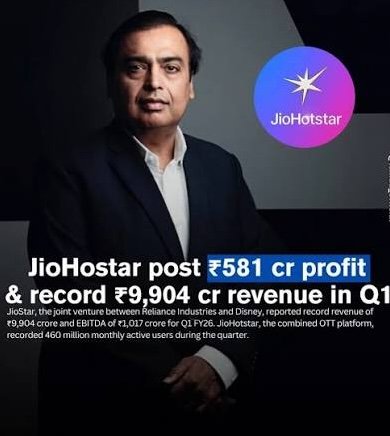
The financial story of JioHotstar in 2025–26 is the rare Indian media narrative where the numbers keep going up and the margins keep going up with them. For FY26, the JioStar media segment reported ₹31,048 crore in operating revenue, ₹4,885 crore EBITDA (15.7% margin) and ₹3,228 crore in profit before tax. The Q1 FY26 print — ₹9,904 crore revenue, ₹581 crore profit, 460 million MAUs — set the pace for a full year of consolidated operations.
The revenue base rests on three legs:
ARPU is the pressure release. India's OTT ARPU is projected to reach USD 40.44 in 2026, with SVOD generating USD 24.58 per user. Every incremental point on ARPU flows straight through to a platform with this much volume.
The tech stack: AI, CTV, and a bet on multilingual India
Streaming a T20 final to 55 million people at the same time is not a media problem. It is a distributed systems problem. And it is the problem JioHotstar has quietly become the world reference point for.
Three technology bets stand out:
- Concurrency engineering. The platform's live infrastructure now sustains peaks that no Western streamer has ever tested — the Champions Trophy final touched 61.2 million concurrent users, the IPL 2025 final 55.2 million. This is a live-streaming league of one.
- AI discovery in the user's language. The OpenAI partnership delivered multilingual voice search during IPL 2026 and a Conversational Discovery feature whose engagement rose every month post-launch. India's linguistic reality — 22 scheduled languages, hundreds of dialects — meets an AI layer that speaks them.
- Connected TV as the new prime time. CTV was the fastest-growing viewing surface in every JioStar disclosure of 2025–26: +54% in IPL 2025, +49% across the season, +19% again in IPL 2026. The living-room television has quietly become an OTT device — and JioHotstar is where it points.
- Commerce as a first-class citizen. The Swiggy in-app ordering integration turned an ad break into a checkout — 50% of orders came from Tier-II+ cities, an audience most digital-commerce products still struggle to reach at scale.
Streaming platforms elsewhere in the world compete on originals. JioHotstar competes on infrastructure. It is the reason 60 million Indians can watch the same over of the same match at the same second, and none of them buffer.
Why this matters if you build brands
If you are a founder, a CMO, or a marketing leader for an Indian brand, the strategic implication of the JioHotstar story is simple and it is a little uncomfortable: the country's attention is now shaped by a single platform, and the platform's terms are what shape your ability to reach it.
That has three consequences worth naming.
- Reach without JioHotstar is now Tier-3 reach. Every other platform — YouTube, Instagram, Netflix, Prime Video, SonyLIV — is a supplement. Not a substitute. Chrome OTT's 93.88% reach number is the ceiling every competitor is measured against.
- Sport-adjacent placement is the highest-value inventory in India. A brand impression next to an IPL over is now benchmarked against Super Bowl inventory globally. And unlike the Super Bowl, this happens 74 times a year, every year.
- Premium non-fiction on JioHotstar is the new brand-story format. A branded compact-feature documentary sitting on the same rail as Criminal Justice or Dhurandhar gets read by the viewer as programming — not advertising. That is the shift Making of Incredible Brands was built to exploit.
Every incredible Indian brand of the next decade will be built somewhere on the JioHotstar rail — either as an advertiser, a sponsor, a content partner, or the subject of a docuseries. The window for "or" is closing. The window for "which" is wide open.
The next 24 months
Three developments to underwrite:
- JioHotstar's non-fiction slate will double. Business docuseries, food, travel, and vernacular reality are all commissioning aggressively. Regional-language non-fiction is the fastest-growing category on the platform.
- Live sport beyond cricket becomes the second flywheel. The Women's Cricket boom is already priced in; F1, Pro Kabaddi, ISL, and the WPL are the next expansion lanes. Each brings a new fan, at a new hour.
- The AI + commerce integration deepens. Expect Conversational Discovery in every major language, in-app checkout on more categories than food, and — over time — a JioHotstar identity that unifies advertising, content, and commerce into one measurable funnel.
Every generation of Indian media has had one dominant surface. Radio. Doordarshan. Cable. DTH. From 2026 onward, it is JioHotstar. Plan accordingly.
Making of Incredible Brands is JioHotstar's compact-feature business docuseries — the natural home for category-leading Indian brands ready to tell their real story on India's largest streaming platform. Season 2 is casting now.
Entrackr Fintrackr — JioHotstar FY26 Financials · StartupTalky — JioHotstar FY26 Revenue & MAU Report · Variety — IPL 2025 & IPL 2026 Viewership Records · Telangana Today — JioStar Billion-Viewer IPL 2025 Report · Advanced Television — JioHotstar IPL 2025 Records · Storyboard18 — JioStar Q1 FY27 Results · SocialSamosa — JioStar Q1 Revenue Report · Chrome OTT Panel · Week 21 2026 (via MediaBrief) · Sci-Tech Today — Top 10 Indian OTT Statistics 2026 · Decentro — Top 12 OTT Platforms in India 2026 · Entertainstar — JioHotstar Complete Guide 2026 · CB Insights — JioStar Merger & Ownership · Sangri Times — Reliance AGM 2026 · The Current — JioHotstar-Nielsen Partnership · JustWatch India Q2 2025 Market Share Panel · Business Standard — JioStar Q2 FY26 Results · Variety — JioStar $1.3B Q1 Report.