
Every founder we filmed for Making of Incredible Brands had a specific sentence — the one that predated the company and would outlast any single strategy. For Dr. Swati Verma, the sentence was small and stubborn: "I was more intrigued in prevention than cure." That is the sentence she left clinical practice with in 2016. Ten years later, it is still the sentence Glamveda is answering — one SKU at a time.
Glamveda is not the loudest brand on this list. It has never raised institutional capital. It does not have a celebrity ambassador the country can name in a beat. What it has is ten calendar years of a specific idea — traditional Indian medicine, met with modern skincare science, priced so a middle-class Indian household can actually buy it — held without a single meaningful pivot. That patience, more than any funding round, is why the brand is a case worth filming.
The founding, in one sentence
Glamveda was founded in 2016 in Ghaziabad by Dr. Swati Verma, a practising doctor turned Ayurveda-and-skincare researcher, alongside co-founder and CMO Vaibhav Sharma. It is registered as a manufacturer — not just a marketing brand — of skincare, makeup and personal-care products that combine Ayurvedic formulations with clinically-tested actives. Ten years in, the company is still bootstrapped: zero external funding, no venture rounds, no exit events.
I had always felt that I could do more than just heal. I was more intrigued in prevention than cure. I ventured on to find natural ways to maintain clean and healthy body, skin and hair. — Dr. Swati Verma, Founder, Glamveda
That founding sentence isn't marketing copy someone else wrote for her. It is the paragraph on the "Our Story" page of Glamveda's own website, in her own voice — the exact founder-story specificity we argue in the framework is trait number four of an incredible brand.
The founder on camera
.jpg)
The MOIB episode with Dr. Verma runs twelve minutes and is one of the quieter portraits in the season. There is no origin-story montage of a Delhi accelerator, no near-collapse in year three that ended with a term sheet. There is a doctor talking about ingredients, and a small production team in Ghaziabad that has slowly figured out how to make hundreds of SKUs at a price its customer can actually afford.
The most useful line from the interview — and the one that will end up on the poster for this article — was Dr. Verma's answer to "why haven't you raised capital?". She did not say "we couldn't" or "we're about to". She said, on record: we don't need to yet, and every year we don't, we control the product 100%. That is a strategic choice, held for a decade, with real costs and real payoffs. It's what makes the brand a case study, not a footnote.
The product philosophy: When Glamour Meets Ayurveda
Glamveda's own tagline — When Glamour Meets Ayurveda — is the shortest legal description of the product philosophy. In practice, it plays out as three commitments the brand has held since day one:

The Glutathione line is the clearest example of Glamveda's product logic. Rather than launching ten unrelated hero SKUs, the brand builds ecosystems around a single active ingredient — face wash, cream, serum, sunscreen, body lotion, soap, mask, and under-eye — priced as a routine, not as individual purchases. The result is a customer who returns for the whole set rather than one tube. It is the D2C playbook, executed by a company that has never taken D2C money.
The Rice & Ceramide bet: Korean skincare, Indian price
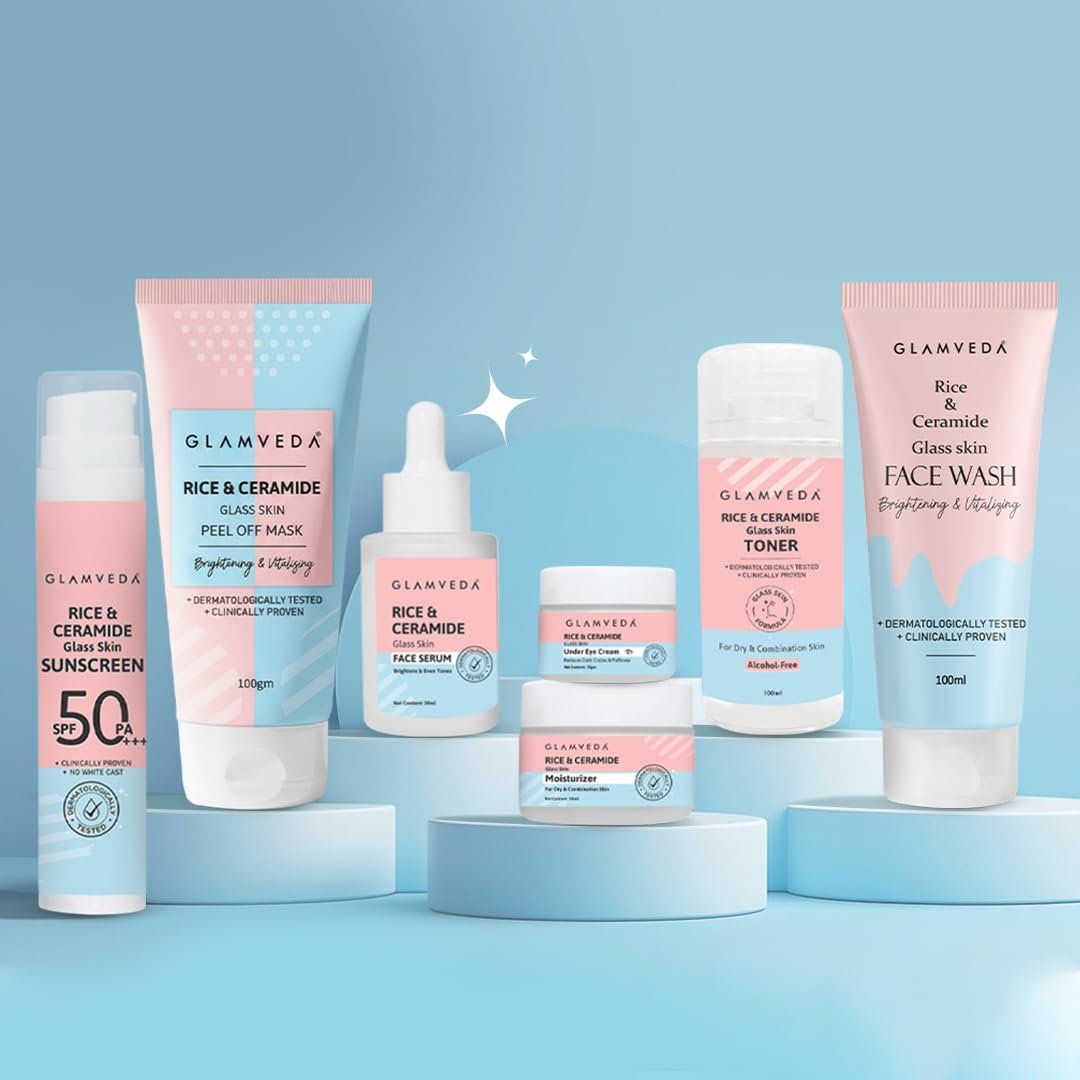
The Rice & Ceramide "Glass Skin" range is Glamveda's clearest read of where the Indian skincare consumer was going before most brands had noticed. K-beauty — Korean skincare's obsession with translucency, hydration and layered routines — went from Instagram niche to Nykaa mainstream sometime in 2023–24. Glamveda had the shelf built out ahead of that wave, in a pink-and-blue design language that reads unmistakably Korean at a glance, with Indian pricing underneath.
Every SKU in the line — face wash, toner, moisturiser, serum, under-eye cream, peel-off mask, sunscreen — is dermatologically tested and clinically labelled. The routine sells as a routine. And crucially, none of it retails over ₹700. That is the specific combination other brands could not match: the visual codes of K-beauty, the science labelling of pharmacy skincare, and the price point of a middle-class monthly grocery.
Glamveda is the perfect amalgam of the ancient knowledge of 5000-year-old Ayurveda and today's modern science. — Glamveda, "Who We Are"
The ingredient story, on the pack
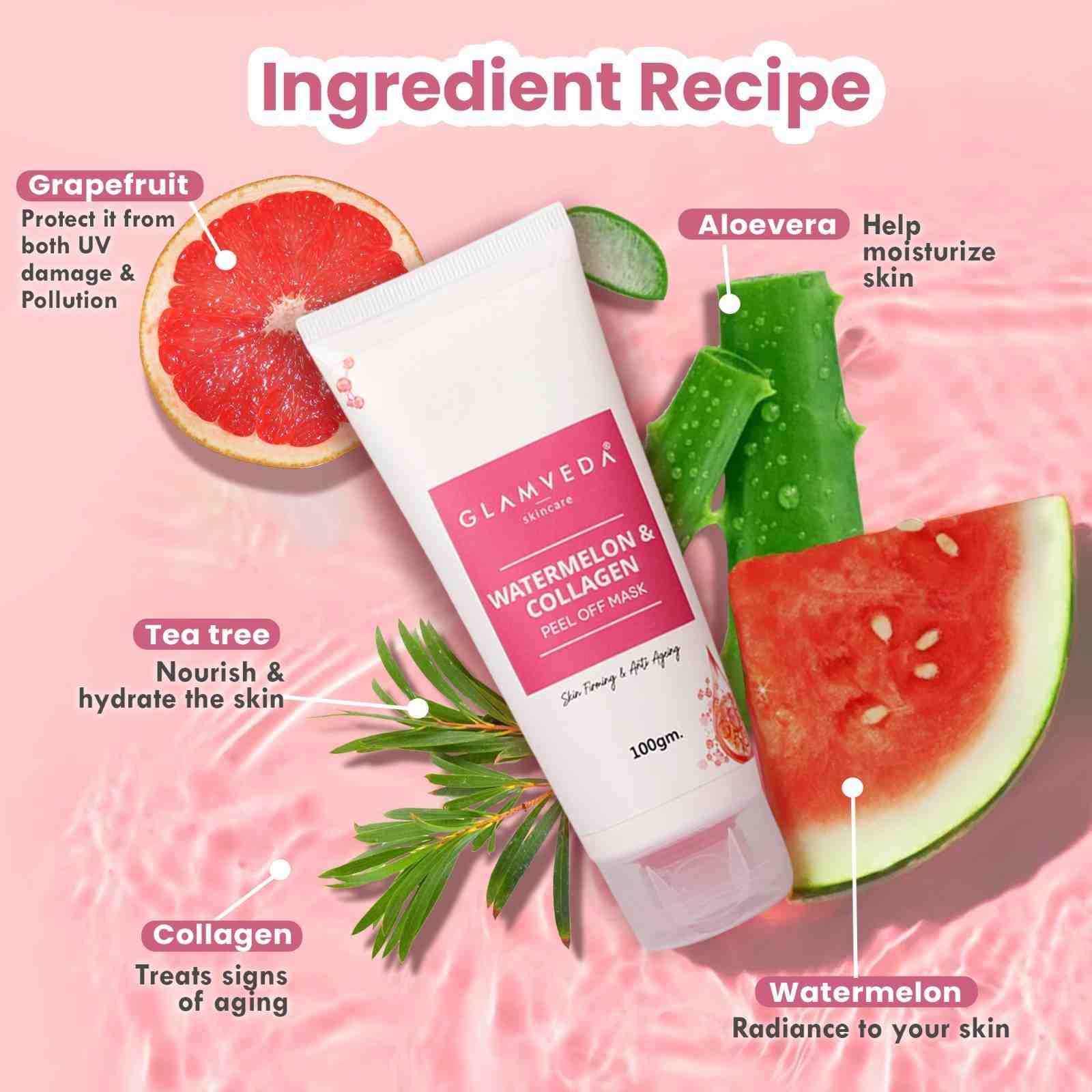
The single most under-discussed decision Glamveda has made is how it does its packaging. Every hero pack is essentially an ingredient recipe printed on the front: watermelon for radiance, aloe vera for moisture, tea tree for hydration, collagen for signs of ageing, grapefruit for UV and pollution. That is not marketing copy. It is a specification. The customer buying the mask can name every reason it is in her routine before she has unscrewed the cap.
This is a decision most bootstrapped Indian skincare brands do not make, because it is more expensive to design and more expensive to print. Glamveda made it in year one and has never walked it back. That decision is why the brand's Amazon reviews read the way they do — customers can articulate why a product worked for them, which means they can recommend it to somebody else with specificity. That is trait number two — a truth simple enough for a stranger to repeat.
The bootstrapped economics
Glamveda has taken zero institutional funding across ten years. It is not a company that could not raise capital; it is a company that has publicly decided not to. That choice has three visible consequences.
- Product control. No board seat, no external stakeholder deciding what to launch next. The Rice & Ceramide bet happened because the founder said it should, not because a fund pushed the roadmap toward growth categories.
- Price control. A brand that raises ₹100 crore has ₹100 crore of growth expectations. Glamveda has grown at the pace its own margins allow, and priced its SKUs where the customer can actually afford them — not where the P&L would prefer.
- Slower shelf, deeper root. Without a funded blitz, Glamveda has taken longer to become a household name than its rivals. Ten years in, the trade-off is looking sound: the brand is present across marketplaces and quick-commerce, without ever having to defend a valuation.
Where they sit against the MOIB framework
Applied to a bootstrapped, category-fluid, doctor-founded brand, our seven-trait framework lands with unusual precision.
The through-line
The reason Glamveda is on Season 1 is not the revenue line. It's the shape of the decisions. A doctor who noticed the same skin complaints appear in her clinic every week decided the more useful business was upstream of the diagnosis. She partnered with a marketer she trusted, refused every offer to be someone else's portfolio company, and spent ten years putting the same tagline on the same shelf, at the same price, for the same customer.
An incredible brand, we argued in the framework, is not a good brand made bigger. Glamveda is a good brand held longer — which is the same argument, told from the other end. Ten years without a pivot, without a rebrand, and without a funding round is a form of endurance the sector rarely rewards in real time. It is, however, precisely the endurance that Making of Incredible Brands was built to notice.
Every incredible brand had a moment where taking outside money would have been easier. The ones we filmed refused, or delayed, and used that refusal as design pressure. Glamveda has refused for a decade.
episode on JioHotstar.
A twelve-minute feature — inside the Ghaziabad production facility, at the desk of the doctor-founder, and on the shelf where the brand actually lives.
Glamveda "Our Story" and "Who We Are" pages · Tracxn company profile (2026) · Founder LinkedIn profiles · MOIB Editorial Desk field notes and on-camera interviews · Product-line pricing verified against glamveda.com catalogue, October 2025 snapshot.